


Suzani embroidery
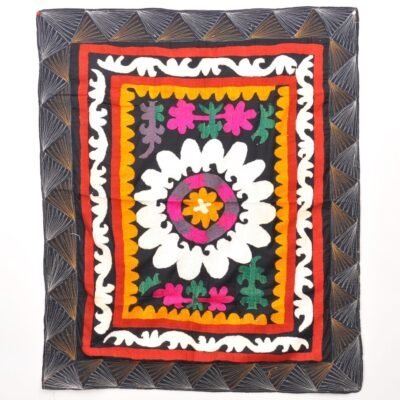
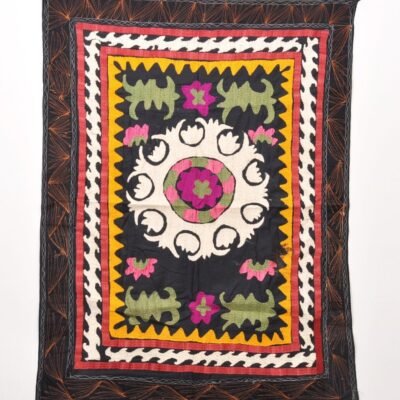
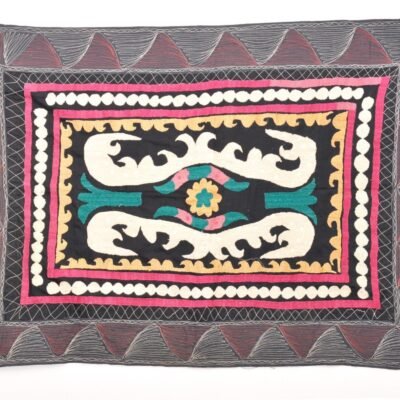
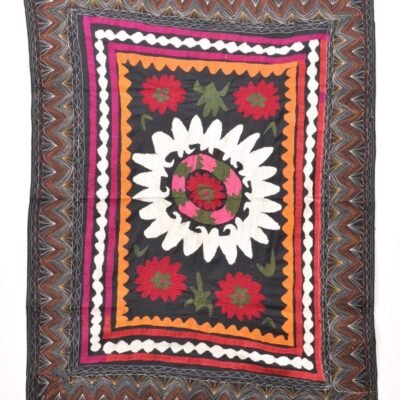
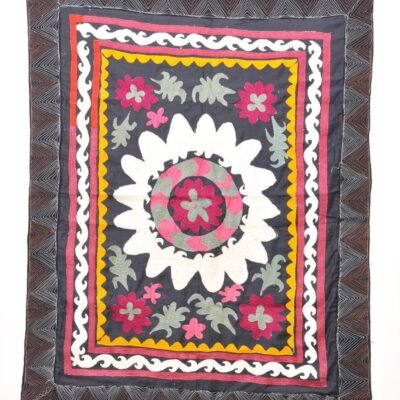
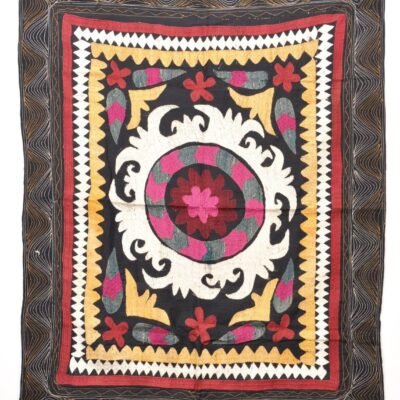
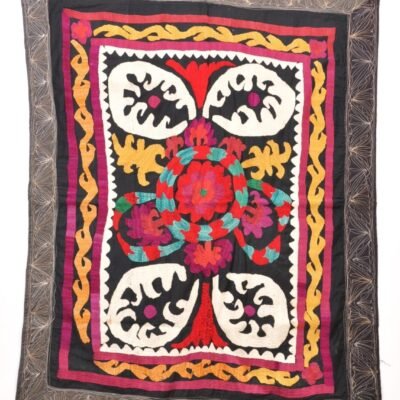
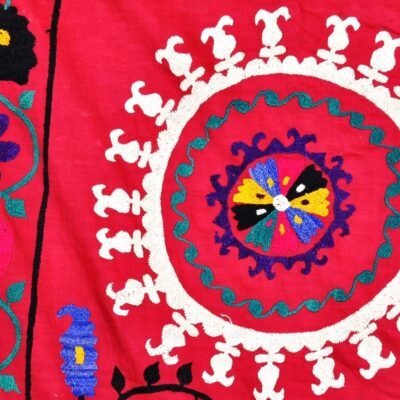
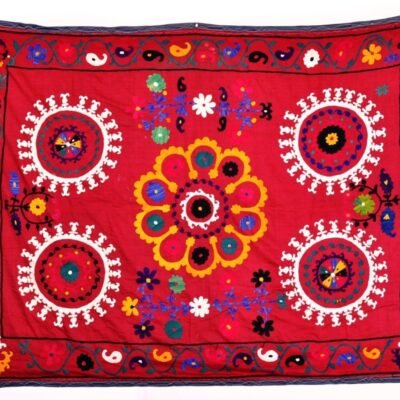
Suzani is more than just beautiful fabric—it’s a centuries-old conversation between generations, told in silk threads and swirling floral motifs.
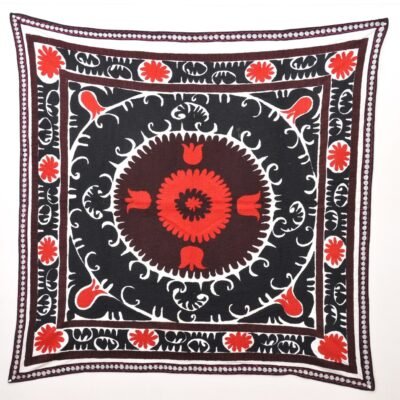
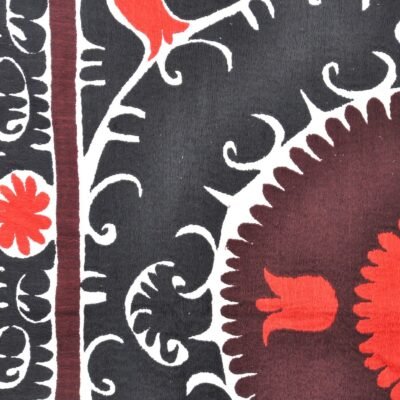
$124.00
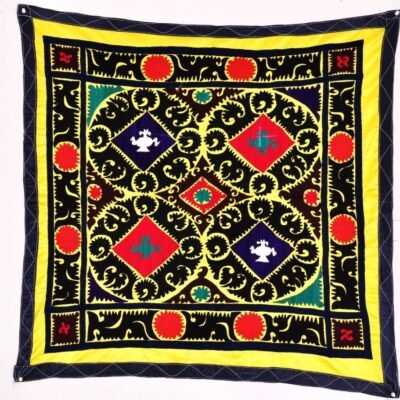
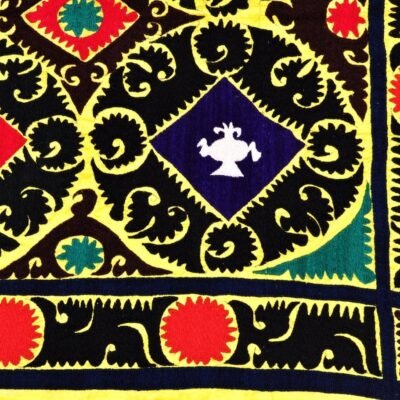
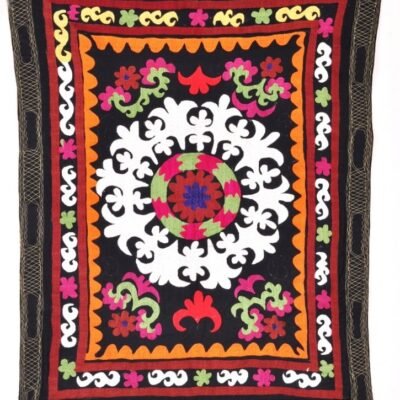
$167.00
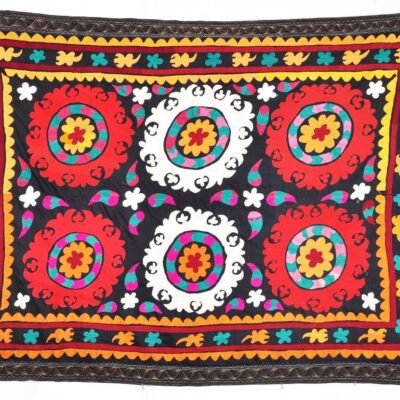
$290.00

$54.00
$196.00
$56.00
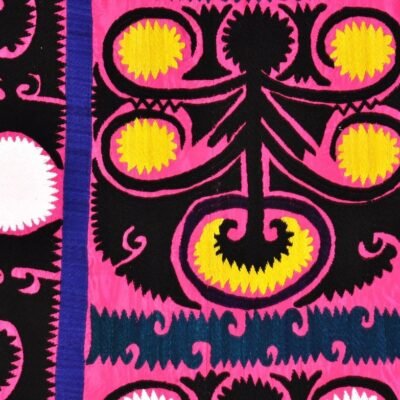
$290.00

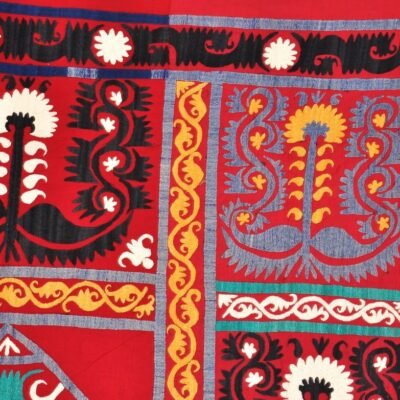
$415.00
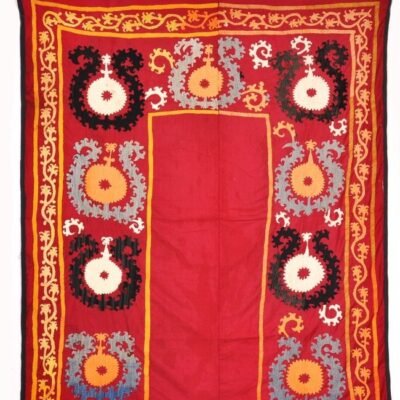
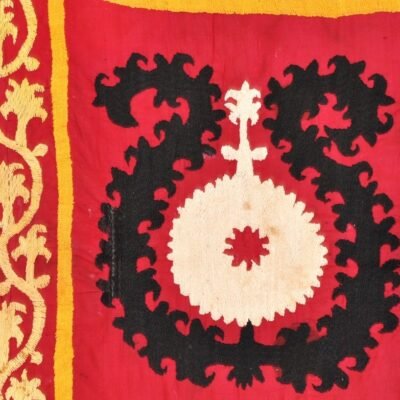
$380.00
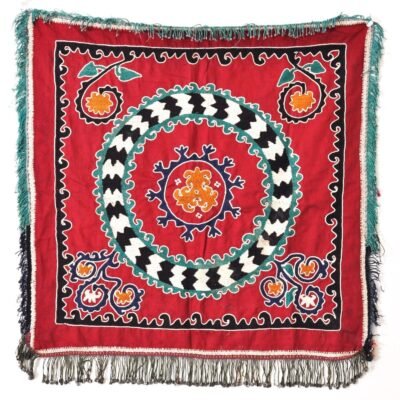
Out of stock
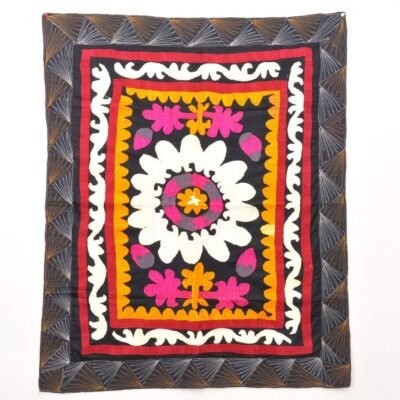
$190.00
$89.00
$195.00
$95.00

$89.00

$89.00
$95.00
$210.00
Suzani embroidery is more than a textile — it is a story stitched by generations.
Born in the heart of Central Asia and carried through the dowry chests of Uzbek families, a Suzani is a hand-embroidered expression of love, protection, beauty, and belonging. Sun disks, pomegranates, vines, wildflowers — every motif blooms with meaning, every stitch holds the touch of a real artisan.
At Alesouk, we curate authentic, hand-embroidered Suzani textiles crafted in Uzbekistan by artisans who continue these ancient traditions with the same patience, rhythm, and devotion their mothers and grandmothers taught them. Whether you’re discovering Suzani embroidery for the first time or searching for the perfect statement piece for your home, you’re in the right place.
Explore the world of Suzani — its meaning, its symbols, its soul — and find a piece that speaks to yours.
→ Shop Authentic Suzani Textiles
Read more
WHAT IS SUZANI EMBROIDERY?
(Clear definition + cultural warmth + artisan focus)
Suzani embroidery is a traditional Central Asian hand-stitching technique, most famously practiced in Uzbekistan, Tajikistan, and neighboring Silk Road regions. The word “Suzani” comes from the Persian/Tajik suzan, meaning needle, a reminder that this entire art form begins with nothing more than fabric, thread, and skilled hands.
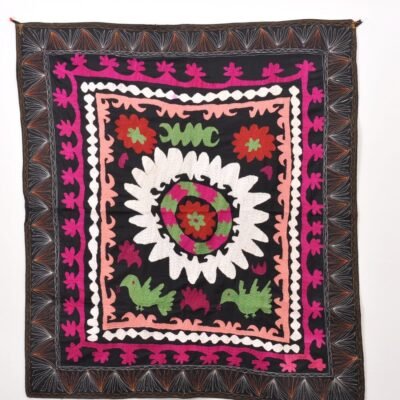
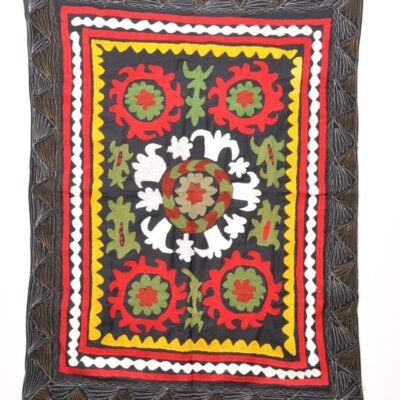
A classic Suzani is embroidered on a base of cotton or silk using silk or cotton threads dyed in rich natural hues. These textiles can be large ceremonial pieces — bedspreads, wall hangings, wedding cloths — or smaller decorative artworks used in daily life. Historically, each Suzani was divided into several panels that different women in a family embroidered separately, then carefully stitched together to form one complete tapestry. This is why older Suzanis often reveal charming irregularities and subtle variations — the human fingerprint of collective creativity.
What makes Suzani so distinct is its symbolic language. Sun and moon medallions for joy and protection. Pomegranate branches for fertility and abundance. Endless vines representing continuity, growth, and the unbroken thread of life. These motifs are not random ornaments — they are the vocabulary of Central Asian womanhood, passed quietly from generation to generation.
To own a Suzani is to bring a piece of this world into your home: storied, soulful, timeless.
WHY SUZANI MATTERS: FROM BRIDAL DOWRIES TO MODERN HOMES
(Deeper emotional, historical storytelling shaped by academic & Russian-language sources)
For centuries, a Suzani was one of the most cherished elements of a young woman’s dowry in Uzbekistan and Tajikistan. Mothers, sisters, aunts, and grandmothers would gather around the fabric, each taking a panel to embroider. Long before the wedding day, the bride’s future was already being stitched into existence — hopes for happiness, prosperity, protection, and a harmonious home. The work could take months or years, and every thread was a quiet wish from one generation to the next.
Many regions kept the tradition of leaving a small motif unfinished, a poetic belief that joy, luck, and creativity must never be “sealed shut.” A Suzani was never meant to be perfect; it was meant to stay alive.
In Russian-language ethnographic writings, Suzani is often described as “домашний оберег” — a household talisman. Not simply décor, but a living presence in the home, symbolizing hospitality, warmth, and the spiritual continuity of the family. Hanging a Suzani in the main room was a gesture of pride and welcome, an invitation to enter a home full of beauty and good intention.
Today, Suzani embroidery has crossed borders and styles, traveling from Silk Road villages into modern apartments, contemporary interiors, and design studios worldwide. What remains unchanged is its essence: a textile that carries memory, artistry, and soul.
Bringing a Suzani into your space is not just about adding color — it is about adding meaning. It is about surrounding yourself with something made slowly, intentionally, by hands that still remember the old rhythms of craft.
MOTIFS & SYMBOLS: THE SECRET LANGUAGE OF SUZANI
Suzani embroidery is instantly recognizable by its vivid patterns — bold circles, blooming flowers, winding vines, protective amulets — yet each motif carries a deeper meaning rooted in centuries of Central Asian tradition. These aren’t just decorations; they are wishes, blessings, and memories expressed through thread.
Below is the living vocabulary of Suzani artistry — the symbols that turn needlework into storytelling.
Sun & Moon Disks — Light, Joy, Protection
Perhaps the most iconic Suzani motif is the round medallion, often called the “shamsa.”
To Central Asian artisans, a perfect circle symbolized:
- The warmth of the sun
- The rhythm of the moon
- The cycle of life
- Protection from misfortune
In many households, these radiant disks were believed to bring happiness and harmony. When placed in the center of a Suzani, the sun motif becomes the “heart” of the textile — a source of light for the entire home.
Pomegranates — Abundance, Fertility, Family
The pomegranate is an ancient symbol woven deeply into Uzbek and Tajik culture. In Suzani embroidery, a cluster of pomegranate seeds represents:
- Prosperity
- Fertility
- Growth
- A large and united family
Traditionally, pomegranates were embroidered onto wedding Suzanis as a blessing for the bride’s future household. Their rich red tones bring warmth, confidence, and timeless beauty into interiors.
Flowers — Youth, Love, Renewal
Each region has its own floral vocabulary, but the most beloved motifs include:
Tulips — dignity, elegance, rebirth
Carnations — joy, vitality
Roses — love, beauty, spiritual awakening
Flowers in Suzani are often stylized rather than literal, blending artistic imagination with the rhythm of nature. The repetition of blossoms — blooming endlessly across a textile — is a quiet prayer for a life filled with beauty and renewal.
Vines, Branches & The Tree of Life — Continuity & Ancestral Roots
The flowing vines that wrap around many Suzanis symbolize:
- Growth
- Continuity
- The journey of the soul
- The lineage that connects generations
In traditional homes, these motifs reminded families of their ancestors and the unbroken thread of heritage — a powerful message embroidered into daily life.
Tumar, Chili Pepper & Amulet Motifs — Protection from the Evil Eye
Central Asian textiles often include symbolic talismans intended to shield the home from negative energy. In Suzani you may find:
- Tumar (triangular amulets)
- Tiny chili-pepper shapes
- Star-like or geometric protective signs
These motifs were believed to guard the family, especially young brides. Their presence on a textile transforms it from simple decoration into a spiritual protector.
Birds, Fish & Celestial Stars — Hope, Good Fortune, Blessings
Less common but deeply meaningful, animal and sky motifs carry gentle symbolism:
- Birds — hope, news, freedom
- Fish — abundance, luck, flowing life
- Stars — divine guidance and a bright future
Together, they create a spiritual landscape embroidered into cloth — a reminder that beauty, luck, and optimism are always within reach.
Why Motifs Matter in Modern Homes
Choosing a Suzani is more than choosing a color palette — it is choosing a story.
Each motif carries an emotional resonance that can shape the energy of a room:
- A sun-disk Suzani adds warmth and confidence.
- A pomegranate Suzani brings richness and celebration.
- A vine-covered Suzani feels grounding, natural, timeless.
- A floral Suzani adds softness and gentle joy.
Designers often select Suzanis not only for their bold visuals but for the feeling they create — a sense of history, meaning, and handmade soul.
HOW SUZANI IS MADE: THE ARTISTRY BEHIND EVERY STITCH
A Suzani is not just embroidered — it is built slowly, lovingly, layer by layer.
Each piece begins with hands, patience, and a rhythm of work passed down through mothers and daughters for centuries. To understand Suzani embroidery is to appreciate the extraordinary craft that gives it life.
Below is the journey of a Suzani from blank cloth to living artwork.
Step 1: Preparing the Fabric Ground
Every Suzani begins with a base cloth, traditionally:
- Handwoven cotton
- Silk
- Or a silk–cotton blend called adras
Artisans stretch the fabric tightly to ensure smooth stitching. Historically, Suzanis were created in separate narrow panels, because looms in Central Asia were small. This is why older pieces show beautiful, visible seams — a reminder that Suzani was always a communal craft.
In modern workshops, some Suzanis are still made in panels, honoring this tradition.
Step 2: Drawing the Pattern — The Work of the Chizmakash
Before a single stitch is made, the design must be drawn.
This is the role of the chizmakash, a master pattern-drawer who outlines the entire composition using charcoal or special ink.
They sketch:
- The central medallions
- The floral borders
- The vines, leaves, and seeds
- The protective amulet symbols
Although the motifs appear organic and free-flowing, each Suzani is carefully balanced — a dance between symmetry and imagination. The chizmakash sets the artistic tone, ensuring that every element complements the others.
This step alone can take hours or days.
Step 3: Choosing the Threads & Colors
Traditionally, Suzani threads were dyed using natural pigments such as:
- Madder root — warm reds, rusts, terracotta
- Indigo — deep blues
- Pomegranate rind — soft yellows and golds
- Walnut shell — browns and smoky earth tones
- Onion skins — vivid oranges
The choice of colors was not random. Red symbolized life and celebration; gold symbolized prosperity; blue protected from the evil eye.
Many artisans today still prefer natural dyes for their depth and softness, while others use high-quality modern threads that ensure durability for contemporary interiors.
At Alesouk, we value both traditions — and our curated collection includes pieces created with each method.
Step 4: Embroidery Begins — The Rhythm of Many Hands
Suzani embroidery is almost always a collective effort.
Traditionally:
- Mothers embroidered the main motifs
- Daughters worked on borders or smaller elements
- Grandmothers added stabilizing stitches or finishing touches
This shared labor made the textile not just an object, but a family heirloom stitched by many hearts.
Embroidery techniques vary by region, but the most iconic stitches include:
Basma (Satin Stitch)
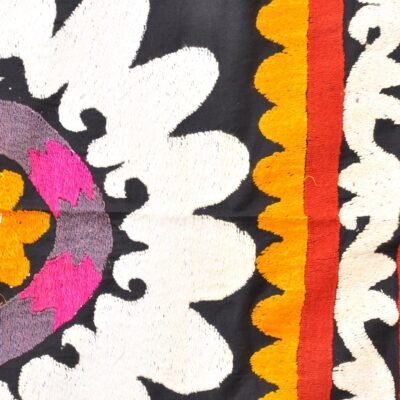
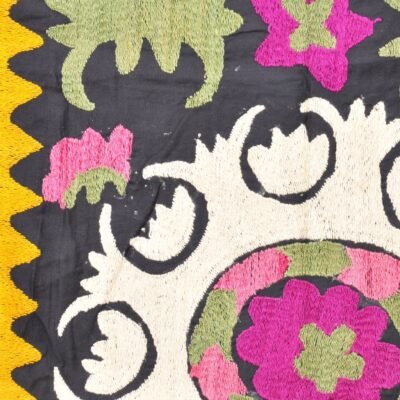
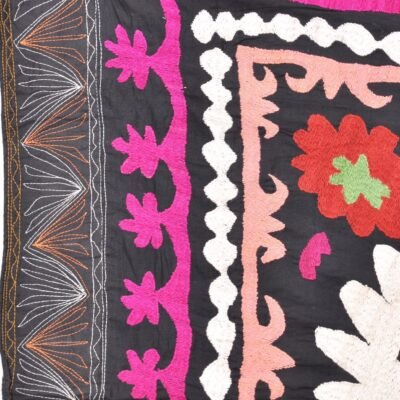
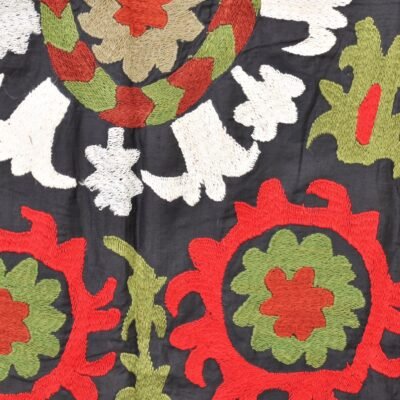
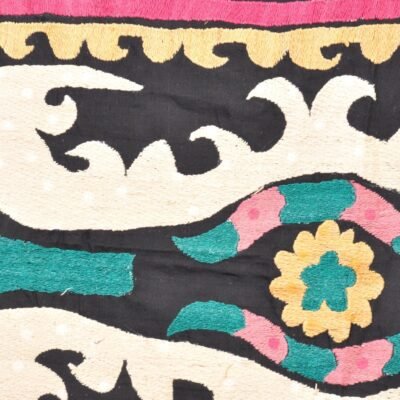
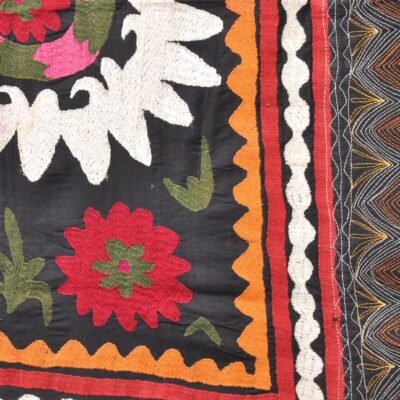
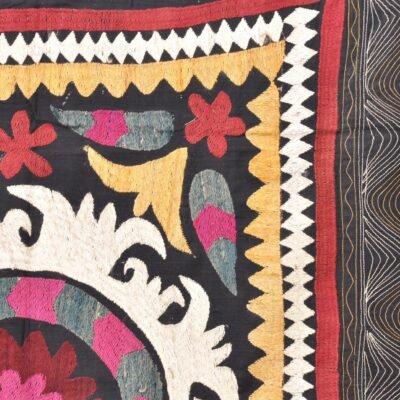
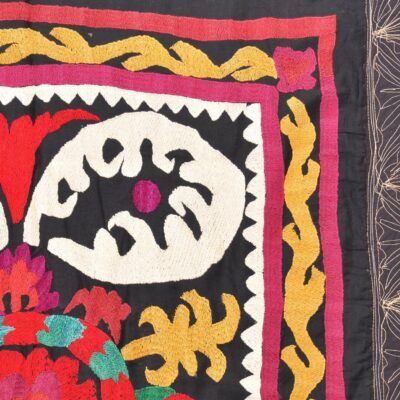
Smooth, dense, and luminous — used for large flower petals, sun disks, and leaves.
Yurma or Chain Stitch (Tambour)
Created with a hooked needle; produces delicate, flowing lines and outlines.
Ilmoq / Buttonhole or Couching Stitches
Used for details, borders, flourishes, and strengthening weak areas.
Each stitch type brings its own texture, allowing Suzanis to feel alive under the fingertips — raised, soft, warm, and deeply human.
The embroidery stage can take weeks or months, depending on size and complexity.
Step 5: Joining the Panels — A Story in the Seams
When all panels are fully embroidered, they are carefully sewn together.
Because each panel was stitched by a different woman, slight variations in tension, color, or density appear at the seams — these are not imperfections but signatures of real craft.
Collectors prize these subtle irregularities. They prove authenticity and tell the story of the hands behind the work.
Step 6: Washing, Pressing & Finishing
Once completed:
- The Suzani is gently washed to soften the fibers.
- Excess dye is removed (especially if natural dyes were used).
- The fabric is pressed and sometimes backed with cotton for stability.
Finally, the artisan reviews the whole textile — checking for loose threads, balancing uneven areas, and ensuring the Suzani is ready for its next home.
The result is a textile that carries weeks of physical labor and generations of inherited knowledge.
The Soul of a Handmade Suzani
In a world of mass-produced textiles, a real Suzani stands apart.
Its slight irregularities, unexpected thread changes, bold motifs, and uneven lines are not flaws — they are the breath of the maker, proof that a human being dedicated time, emotion, and intention to create something unique.
Every Suzani is a one-of-a-kind masterpiece.
No two are the same.
And that is its magic..
REGIONAL STYLES & TYPES OF SUZANI
Suzani embroidery is not a single style — it is a constellation of regional traditions shaped by geography, history, and local identity. Every city of Uzbekistan once had its own embroidery school, its own motifs, its own favorite colors. A trained eye can often guess where a Suzani comes from just by looking at its sun disks, borders, and stitching.
Below is a journey through the major regional styles — each with its own personality, symbolism, and visual rhythm.
The Major Suzani Traditions of Uzbekistan & Central Asia
Bukhara Suzani: The Golden Heart of Uzbekistan
Bukhara Suzanis are among the most admired and collectible. They are known for:
- Large central medallions (sun or moon disks)
- Bold carnation and leaf patterns
- Deep reds, burgundies, and burnished golds
- Dense satin stitching (basma) that creates a glowing, tapestry-like surface
Bukhara pieces often feel regal — dramatic, rich, and confident. They were typically used as wedding textiles and dowry gifts, symbolizing strength, warmth, and prosperity.
Best for interiors: Statement wall hangings, grand living rooms, warm-toned spaces.
Samarkand Suzani: Floral, Free-Flowing & Joyful
Samarkand Suzanis have a softer, more lyrical character. Their signatures include:
- Flowing floral patterns — vines, blossoms, delicate branches
- More open space between motifs, giving a light, airy composition
- Bright color palettes: pomegranate red, apricot, indigo, sage, and gold
- Chain-stitch lines that create graceful movement across the textile
Samarkand embroidery feels romantic and poetic, blending ancient symbolism with artistic freedom.
Best for interiors: Bedrooms, airy modern spaces, feminine or bohemian environments.
Shakhrisabz Suzani: The Embroidered Garden
Shakhrisabz (the birthplace of Amir Timur) produces Suzanis known for:
- Lush botanical motifs — oversized flowers, abundant foliage
- Vibrant reds, greens, and oranges
- Bold, energetic compositions
- Heavy stitching with a sense of fullness and life
A Shakhrisabz Suzani radiates energy and optimism. Its motifs feel almost alive, like a garden in bloom.
Best for interiors: Dining rooms, family spaces, eclectic décor.
Nurata Suzani: The Jewel of the Steppe
Nurata Suzanis have a very distinct visual identity. They feature:
- Star-like medallions and celestial symbols
- Elegant vines and leaf chains
- A preference for deep reds, greens, and navy blues
- Finer lines and delicate detailing
Nurata embroiderers created textiles that feel mystical, almost cosmological—reflecting the region’s ancient beliefs in the protective power of stars and sacred geometry.
Best for interiors: Bedrooms, meditation rooms, artistic and architectural spaces.
Tashkent / Fergana Valley Suzani: Light, Elegant & Everyday Friendly
Suzani traditions from Tashkent and the fertile Fergana Valley tend to be:
- Lighter in color — creams, sky blues, soft reds
- More geometric and symmetrical
- Refined rather than dramatic
- Rich in floral sprays and repeating motifs
These Suzanis are beloved for their balance and simplicity. They adapt beautifully to modern interior styles, including Scandinavian, minimalist, and transitional décor.
Best for interiors: Modern apartments, soft neutral interiors, small spaces.
Tajik Suzani (Ura-Tube / Istaravshan & Khujand)
Tajik Suzanis are close relatives of Uzbek styles but possess their own flair:
- Snowflake-like rosettes and star symbols
- Fine chain stitching and flowing rhythm
- Cooler-toned palettes with deep blues and purples
- Smaller motifs scattered evenly across the surface
These textiles reflect the mountainous Tajik landscape — serene, spiritual, and intricately layered.
Best for interiors: Calm, contemplative rooms; traditional and antique-inspired décor.
Why Regional Styles Matter Today
Understanding the style of a Suzani helps you:
- Choose the textile that feels right for your home
- Appreciate the craftsmanship and symbolism behind each piece
- Connect emotionally with the traditions that shaped it
- Build a curated collection with diversity and depth
As you browse Alesouk’s Suzani collection, you may recognize elements from different regions — each textile carrying not just beauty, but heritage.
SUZANI IN MODERN INTERIORS: HOW TO USE IT IN YOUR HOME
Hand-embroidered Suzani textiles bring an instant feeling of warmth, artistry, and soul to any space. Their rich colors and symbolic patterns allow them to shine equally in bohemian homes, minimalist apartments, traditional interiors, and contemporary design studios.
A Suzani is not just décor — it is a statement piece that transforms a room with history, texture, and story.
Below are the most beautiful and practical ways to style Suzani in modern interiors.
Suzani as Wall Art: The Easiest Way to Create a Statement
Hanging a Suzani on the wall is one of the most impactful ways to display it.
Its bold motifs and large scale create a dramatic focal point, turning even a simple room into a curated, culturally rich space.
Why it works:
- Adds height, depth, and warmth
- Introduces color without overwhelming the room
- Replaces expensive artwork with something more meaningful
- Creates a museum-like display that feels both eclectic and refined
Styling ideas:
- Hang a large Bukhara Suzani above a sofa or bed for a grand, gallery-quality look.
- Frame a smaller Samarkand floral panel for a modern, architectural effect.
- Display a Suzani in a dining room to spark conversation and warmth.
Tip: Pair with neutral walls to let the embroidery become the star.
→ Explore Suzani Wall Hangings
As a Bedspread or Layered Throw: Comfort Meets Culture
A Suzani draped over the bed instantly elevates the room, adding texture and emotional warmth.
How to use it:
- Spread a full-size Suzani over the bed for a romantic, bohemian look.
- Use it as an accent throw folded at the foot of the bed.
- Layer it over natural linens for a soft, earthy aesthetic.
Best styles for bedding:
- Samarkand florals for a softer mood
- Shakhrisabz garden motifs for brightness and joy
- Nurata celestial patterns for a peaceful, meditative atmosphere
→ Shop Full-Size Suzani Textiles
Cushions & Pillows: The Most Versatile Way to Use Suzani
Suzani pillows are the easiest way to introduce heritage textiles into your home. Their smaller size makes them perfect for experimenting with color and pattern.
Why designers love them:
- They add instant charm and character
- They play beautifully with neutral sofas and armchairs
- They combine well with ikat, velvet, linen, or plain cushions
- Each pillow is unique, like a piece of art
Styling tips:
- Mix large sun-disk pillows with smaller floral ones for balance.
- Use two bright Suzani cushions as accents on a minimalist sofa.
- Pair with textured throws for a layered, global-inspired look.
→ Discover Suzani Pillow Covers
Upholstery & Furniture Accents: Bold, Artistic & Unexpected
For those who love bold interiors, Suzani textiles used for upholstery make unforgettable statement pieces.
Where to use them:
- Bench seats
- Ottomans
- Headboards
- Accent chairs
- Entryway stools
Best Suzani types for upholstery:
- Durable cotton-backed pieces
- Shakhrisabz and Bukhara styles with strong motifs
- Modern-weight Suzanis designed for everyday use
Interior effect:
A Suzani-covered bench or chair becomes the heart of the room — a marriage of comfort and cultural history.
Note: Antique or delicate silk Suzanis should not be used for heavy-use upholstery. They are best displayed as art or bedding.
In Minimalist & Modern Spaces: A Point of Warmth
Even if your home is minimal, Scandinavian, or contemporary, Suzani works beautifully because:
- It softens clean lines
- It injects just enough color
- It feels handcrafted among machine-made surfaces
- It adds soul without adding clutter
Place one Suzani textile in a minimalist room and watch the entire mood change — suddenly the space feels lived-in, meaningful, human.
In Small Apartments: A Big Impact with One Piece
In urban apartments or compact interiors, Suzani is perfect because:
- A single textile can replace multiple décor items
- It saves space while adding visual depth
- It creates warmth without crowding the room
Try:
- A Suzani above the sofa instead of a gallery wall
- A Suzani bedspread in a studio apartment
- Two decorative pillows for color and charm
Small spaces benefit from big stories.
Layering Suzani with Other Textiles: A Designer’s Secret
Suzani pairs beautifully with:
- Ikat (for a Central Asian-inspired look)
- Velvet (rich, luxurious, moody)
- Linen (neutral, earthy, modern)
- Vintage kilims (eclectic warmth)
A layered textile story feels curated rather than chaotic.
The Emotional Impact: What Suzani Brings into a Home
There’s a reason designers and collectors keep returning to Suzani textiles:
- They bring warmth
- They add soul and authenticity
- They introduce symbolism that enriches the space
- They carry stories of real artisans
- They create a feeling of heritage even in the most modern home
A Suzani doesn’t just decorate a room — it transforms it.
HOW TO CHOOSE AN AUTHENTIC SUZANI (BUYING GUIDE)
Your guide to understanding quality, originality, and craftsmanship.
A Suzani is not just a purchase — it is an heirloom, a piece of history, and a handmade artwork that can stay in your family for generations. Because every Suzani is unique, choosing the right one means understanding what makes a textile truly authentic and how to find the piece that resonates with your home, your taste, and your heart.
Below is Alesouk’s carefully curated guide to selecting a genuine, high-quality Suzani.
Hand-Embroidered vs. Machine-Made: How to Tell the Difference
Authentic Suzanis are 100% hand-embroidered.
Machine-made pieces may look neat, but they lack the warmth, irregularity, and soul of real craftsmanship.
Signs of a true hand-embroidered Suzani:
- Slight variations in stitch length — not perfectly uniform
- Organic flow of motifs rather than rigid, computer-perfect lines
- Occasional knots or loose thread ends on the backside
- Depth and texture you can feel when you run your fingers across it
- Gentle “movement” in the embroidery, as if alive
Signs of a machine-made imitation:
- Extremely even stitches with no variation
- Flat, lifeless texture
- Repeated patterns with mathematical precision
- Backing fabric that hides all embroidery traces
At Alesouk, every Suzani we offer is hand-embroidered by artisans in Uzbekistan — the genuine article.
Understanding Fabrics: Cotton, Silk & Silk-Cotton Blends
Authentic Suzanis are typically embroidered on:
- Cotton: durable, lightweight, ideal for wall hangings, pillows, and bedding
- Silk: luxurious, luminous, best for decorative or special pieces
- Silk-cotton blends (adras): a traditional base with a soft sheen
How to choose the right base:
- Choose cotton for pieces you want to use daily (bed throws, pillows).
- Choose silk for statement art pieces and ceremonial textiles.
- Choose silk-cotton blends for balanced beauty and durability.
Natural vs. Synthetic Dyes: Does It Matter?
Traditional Suzani artisans used natural dyes, giving colors a deep, earthy glow:
- Madder → red, rust, terracotta
- Indigo → blue
- Pomegranate rind → yellow
- Walnut shell → brown
Natural dyes age beautifully and gain character over time.
Modern Suzanis are often made with high-quality synthetic dyes that are more colorfast and practical for everyday interiors.
Which should you choose?
- For collectors → choose natural dyes
- For interior use → synthetic dyes are perfectly fine and often more stable
Both are legitimate — what matters is the quality of the embroidery.
Vintage vs. Contemporary Suzani: What’s the Difference?
Vintage Suzani (20–80 years old):
- Softer colors
- Visible aging, patina, and charm
- More unique patterns from traditional workshops
- Often higher collectible value
Contemporary Suzani:
- Brighter, cleaner color palettes
- Often more affordable
- Perfect for modern décor and everyday use
- Available in many sizes for different interiors
Which is right for you?
- If you love history → choose vintage
- If you love bold color → choose contemporary
- If you want flawless condition → choose new artisan-made pieces
Alesouk offers both, carefully curated for quality and authenticity.
Examine the Back of the Textile: The Secret to Authenticity
One of the easiest ways to evaluate a Suzani is to gently examine its backside.
What you should see:
- Threads traveling between motifs
- Areas where colors overlap
- Tiny knots or thread changes
- Uneven spacing — a sign of human handwork
If the back is perfectly neat or completely covered with fabric:
The textile is likely machine-embroidered or mass-produced.
Authentic Suzanis proudly show their imperfections — they are part of the story.
Evaluate Stitch Density & Texture
High-quality Suzani embroidery has:
- Dense stitching in major motifs
- Cleanly outlined shapes
- Strong definition of borders
- Smooth transitions between colors
However, density varies by region:
- Bukhara → very dense satin stitch
- Samarkand → lighter, airy chain stitch
- Nurata → fine, detailed celestial motifs
Understanding regional differences helps you appreciate variety — not judge by the wrong standard.
Sizing: How to Choose the Right Dimensions for Your Space
Suzanis come in many sizes. Choose according to use:
Wall Hangings
- Medium (100–130 cm wide) → above small sofas, entryways
- Large (150–200+ cm wide) → statement pieces above beds or in living rooms
Bedspreads
- Full / Queen / King → oversized Suzani textiles
Pillows
- 40×40 cm → classic sofa size
- 50×50 cm or 30×60 cm → luxury-scale accent pieces
Throws / Table Covers
- 120–150 cm → versatile functional pieces
A small Suzani can transform a room. A large one can define it.
Understand the Story Behind the Piece
In Central Asia, Suzanis were:
- Dowry textiles
- Symbols of protection and prosperity
- Blessings for the home
- Passed from mother to daughter
When choosing your Suzani, look for the story:
- What motifs dominate it?
- Does it feel bright, mystical, grounded, joyful, or serene?
- Which region inspired its style?
- What emotion does it evoke?
Your home will reflect whatever story you bring into it.
Ethical Sourcing & Fair Artisan Support
Authentic Suzani is not just craftsmanship — it is culture.
Supporting true artisans ensures:
- Traditional knowledge survives
- Rural women earn fair, sustainable income
- Natural dye traditions continue
- Each piece remains a meaningful cultural object
Alesouk works directly with artisans, families, and workshops in Uzbekistan, ensuring every Suzani honors its heritage and sustains its makers.
Final Advice: Choose with Your Eyes, Your Hands & Your Heart
The right Suzani will speak to you.
- Look for colors that uplift you
- Feel the embroidery — warmth reveals authenticity
- Notice the motifs that resonate with your personal story
- Imagine how it will transform your home
A Suzani is not just décor — it is a companion textile, alive with memory and meaning.
CARE & PRESERVATION: MAKING YOUR SUZANI LAST
A Suzani is a living textile — touched by human hands, created with natural materials, and rich with delicate embroidery. Proper care ensures that your Suzani not only remains beautiful for many years, but becomes a beloved heirloom filled with stories of its own.
Caring for your Suzani is simple when you understand its needs. Here is everything you need to know.
Everyday Care: Gentle, Simple, Consistent
Suzanis do not require constant cleaning. In fact, gentle, minimal care is often the best approach.
Basic daily care tips:
- Shake or lightly dust the textile to remove surface dust
- Avoid exposing it to direct, strong sunlight for long periods
- Keep it away from moisture, damp rooms, or household humidity
- Rotate or reposition it occasionally if hung on the wall
These small habits keep your Suzani vibrant and prevent fading or uneven wear.
Cleaning Your Suzani: When and How
Spot Cleaning
Most spills can be handled easily:
- Use a clean, soft cloth
- Dab gently — never rub
- Use cold water only
- If needed, add a drop of mild, fragrance-free soap
Avoid excessive moisture. Suzani embroidery, especially silk-based, prefers a delicate touch.
Professional Cleaning
For deep cleaning, vintage pieces, or large bedspreads:
- Seek a professional textile cleaner
- Choose someone experienced with hand-embroidered or antique fabrics
- Never dry-clean valuable or delicate Suzanis without expert advice
Professional cleaning should be done rarely — only when truly needed.
Caring for Vintage & Antique Suzanis
Older Suzanis carry natural aging: softened colors, relaxed fabric, small irregularities. These qualities are part of their charm and historical authenticity.
To protect vintage textiles:
- Keep them away from harsh light
- Avoid hanging them by tight nails or clips (use soft hanging sleeves instead)
- Do not place heavy objects on them
- Avoid vacuuming directly — use gentle dusting instead
- Store them with acid-free tissue if not displayed
Vintage Suzanis should be treated more like artwork than everyday textiles.
Hanging a Suzani: Display Without Damage
A Suzani can be hung in several safe ways:
Preferred methods
- Sew a fabric sleeve to the back for a wooden rod
- Use Velcro strips mounted on a textile-safe backing
- Hang with gentle, wide clips padded with natural fabric
Avoid
- Thin nails
- Metal hooks piercing the fabric
- Tight pins that strain embroidery threads
The goal is to support the textile evenly so it hangs gracefully without stress.
Storing Your Suzani: Keeping It Safe for Years
If you rotate your textiles seasonally or store them between uses, proper storage is essential.
Best practices:
- Roll, don’t fold, when possible (to avoid deep creases)
- Use acid-free tissue or cotton fabric as wrapping
- Store in a breathable cotton bag — never plastic
- Keep in a cool, dry, dark environment
- Add natural moth repellents (cedar, lavender) near — not on — the textile
Never store Suzani textiles in basements, attics, or sealed plastic bins.
Care for Suzani Used as Upholstery
If you use Suzani as upholstery on benches, chairs, or headboards:
Tips:
- Keep upholstered areas away from direct sun
- Avoid placing heavy objects on embroidered surfaces
- Spot clean only
- Use a fabric protector spray only if safe for delicate embroidery
- Consider occasional rotation between “display use” and “resting use”
For antique Suzanis, upholstery is not recommended — display them instead.
How to Refresh a Suzani Without Washing
If your Suzani looks slightly wrinkled or needs a fresh look:
- Use a steamer from a safe distance (never allow direct moisture contact)
- Lay the textile flat for several hours to relax creases
- Air it out in a shaded, breezy area — sunlight is not needed
This gentle refresh restores life to the textile without risking damage.
Long-Term Preservation: Treat It Like Art
When cared for with attention, a Suzani can live for generations.
Treat your Suzani with the same respect as fine art:
- Protect it from UV exposure
- Display it in a clean, stable environment
- Handle gently with clean, dry hands
- Appreciate its age and embrace its irregularities
Remember: a Suzani is not meant to remain frozen in perfect newness.
Its softness, its patina, its delicate aging — these are the marks of a life shared with you.
The Heart of Suzani Care
Caring for your Suzani is not a burden — it is a continuation of its story.
For centuries, women embroidered Suzanis with hopes for joy, abundance, and protection. When you care for yours, you honor not only the textile, but the lineage of hands that created it.
With gentle love, your Suzani will remain a treasured companion in your home for decades to come.
FROM TRADITION TO MODERN DESIGN: SUZANI IN TODAY’S FASHION & CULTURE
Suzani embroidery may be centuries old, but its spirit is vibrantly alive. What began as a dowry tradition in Central Asian households has transformed into a global design language — embraced by fashion designers, interior stylists, collectors, and artisans around the world. Its motifs, once stitched for blessings and protection, now appear in homes, boutiques, galleries, and even on international runways.
Suzani is no longer only a textile.
It is a cultural ambassador — a bridge between past and present.
A Revival of Craft: Why the World Is Falling in Love with Suzani Again
Across continents, people are seeking authenticity, craftsmanship, and stories behind the objects they bring into their homes. Suzani embodies all three.
What draws modern creators and collectors to Suzani?
- Human-made artistry in a digital, fast-paced world
- Symbolism and meaning that add emotional depth
- Bold, expressive patterns perfect for contemporary design
- Sustainable handwork, far from mass production
Designers describe Suzani as "alive" — a textile that transforms the mood of a space simply by being present.
Suzani on Global Runways & High Fashion
Top designers have incorporated Suzani motifs into:
- Haute couture jackets and coats
- Embroidered handbags
- Boho-chic dresses and skirts
- Luxury homewear and artisanal fashion lines
Their appeal is clear: Suzani embroidery brings a sense of global heritage and artist-made detail that stands out in a world of uniformity.
The richness of a Suzani floral or sun medallion adds drama and romance to garments, marrying folk tradition with high fashion.
Interior Designers’ Secret Weapon
Interior designers across Europe, America, and the Middle East increasingly choose Suzani textiles for their projects. Why?
- They add instant warmth
- They pair beautifully with modern minimalism
- They introduce color without overwhelming the room
- They balance luxury with handmade authenticity
From boutique hotels in Paris to bohemian lofts in Brooklyn and serene villas in Bali, Suzani textiles offer an effortless blend of art and comfort.
Designers often describe Suzani as the “soul piece” that pulls a room together.
Museums & Cultural Institutions Embrace Suzani Heritage
In recent years, Suzani has appeared in:
- Textile exhibitions
- Museum collections
- Cultural heritage projects
- Academic research on Central Asian arts
Curators highlight Suzanis for their:
- Mastery of embroidery technique
- Symbolic richness
- Connection to women’s history and domestic art
- Blend of Islamic, Persian, and nomadic influences
This recognition elevates Suzani from folk craft to global textile art.
Artisans Today: Keeping the Thread Alive
While the world admires Suzani embroidery, its heart remains in the hands of the artisans who continue the tradition.
Today’s embroiderers in Uzbekistan and Tajikistan:
- Use ancient patterns passed down through family apprenticeships
- Develop new color palettes for modern homes
- Balance tradition with creativity
- Sustain rural economies through fair-trade craft
Many younger artisans — especially women — are reviving Suzani as both cultural pride and economic empowerment. Their work blends heritage and innovation, ensuring that the craft evolves without losing its identity.
At Alesouk, we are honored to support these artisans and help bring their work to homes around the world.
A Global Aesthetic with Local Soul
Suzani’s journey from Central Asian dowry chests to modern living rooms mirrors a global shift toward:
- Authenticity over trends
- Craftsmanship over mass production
- Cultural depth over disposable décor
Whether used as a pillow, a wall tapestry, or a fashion accessory, Suzani tells a story — a human story. This emotional resonance explains why it remains timeless, even as styles change.
Suzani is not just “in style.”
It is beyond style — rooted in heritage, expressive in design, and endlessly adaptable.
What Suzani Means Today
In the modern world, Suzani has become a symbol of:
- Cultural appreciation
- Slow craft
- Sustainable beauty
- Emotional interior design
- Connection to handmade traditions
It brings meaning into our spaces — reminding us that beauty is strongest when it is created by human hands.
SUZANI EMBROIDERY: FREQUENTLY ASKED QUESTIONS (FAQ)
Short, elegant answers designed for quick understanding — and perfect for Google’s featured snippets.
- What is Suzani embroidery?
Suzani embroidery is a traditional Central Asian textile art, especially from Uzbekistan and Tajikistan, featuring hand-embroidered motifs such as sun medallions, flowers, vines, and protective symbols. Each piece is stitched with silk or cotton threads onto cotton or silk fabric, creating a vibrant, symbolic artwork used for home décor and ceremonial purposes.
- What is Suzani used for?
Suzani textiles are used as wall hangings, bedspreads, throws, pillows, table covers, and upholstery accents. Historically, Suzanis were part of bridal dowries and household rituals; today, they bring warmth, color, and cultural meaning into modern interiors.
- How is Suzani made?
A Suzani is created through a multi-step process: the pattern is drawn onto fabric, then embroidered by hand using satin, chain, or couching stitches. Artisans work on separate panels that are later sewn together. The result is a richly textured textile, often with charming irregularities that reflect its handmade nature.
- How can I tell if a Suzani is authentic and handmade?
Look for slight irregularities in stitches, visible thread transitions on the back, organic movement in motifs, and a textured surface. Authentic Suzanis show evidence of handwork — unlike machine-made pieces, which appear perfectly uniform and flat. Handmade Suzanis also have deeper colors and more expressive patterns.
- What do Suzani patterns mean?
Suzani motifs carry symbolic meaning:
- Sun & moon disks → joy, protection
- Pomegranates → abundance, fertility
- Flowers → love, beauty, renewal
- Vines & branches → continuity and growth
- Tumar/amulet shapes → protection from the evil eye
Each pattern reflects cultural blessings woven into daily life.
- How do I care for a Suzani textile?
Dust gently, avoid direct sunlight, and spot clean with mild soap and cold water. For deep cleaning, use a professional textile specialist. Store rolled (not folded) in breathable cotton, away from moisture. Treat antique pieces like art — with gentle handling and careful display.
- Can I use Suzani for upholstery?
Yes — many contemporary Suzanis are durable enough for light upholstery on ottomans, benches, and headboards. However, antique or silk-based Suzanis should never be used for heavy-use upholstery, as the embroidery and fabric are too delicate. Cotton-backed or modern-weight Suzanis are best for furniture.
- What is the difference between vintage and new Suzani?
Vintage Suzanis (20–80 years old) have softened natural dyes, visible aging, and unique regional styles — ideal for collectors. New Suzanis often feature brighter colors, cleaner lines, and consistent quality, making them perfect for everyday home décor. Both are handmade; the choice depends on your aesthetic and purpose.
- Where does Suzani originate?
Suzani originates from Uzbekistan and Tajikistan, especially Bukhara, Samarkand, Shakhrisabz, Nurata, Tashkent, and the Fergana Valley. These regions developed distinct embroidery traditions, each with its own motifs, color palettes, and stitching techniques.
- Can Suzani be washed at home?
Small, sturdy cotton-based Suzanis can be spot cleaned at home, but full washing is not recommended. For larger or silk-based pieces, always use a professional cleaner. Avoid harsh chemicals, high heat, or soaking — these can damage the embroidery.
- How do I choose the right Suzani for my home?
Consider the color palette, motif meaning, size, and intended use. For statement walls, choose large medallion Suzanis. For beds, select full-size textiles. For sofas, start with pillows. Choose motifs that resonate emotionally — a Suzani should feel like a piece of art that belongs in your life.
- Is each Suzani unique?
Yes — every Suzani is one of a kind. Variations in stitching, color, pattern layout, and artisan technique ensure that no two pieces are identical. This uniqueness is part of the beauty of collecting handmade textiles.
- Why are some Suzanis more expensive than others?
Price depends on factors such as:
- Hand-embroidery quality
- Stitch density
- Size
- Age (vintage vs. contemporary)
- Materials (silk vs. cotton)
- Artisan skill and region of origin
Vintage and silk-embroidered pieces are typically the most valuable.
- Does Suzani work with modern interior styles?
Absolutely. Suzani pairs beautifully with Scandinavian, minimalist, bohemian, rustic, eclectic, and contemporary décor. Its handcrafted texture brings warmth and character to clean, modern spaces.