


Uzbek Suzani Embroidery
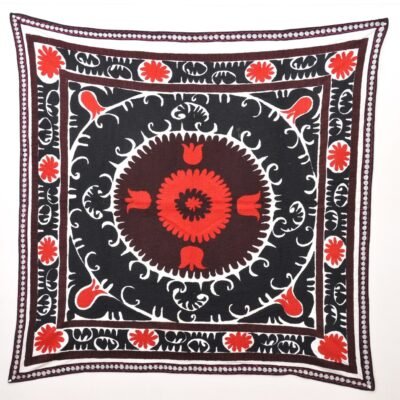
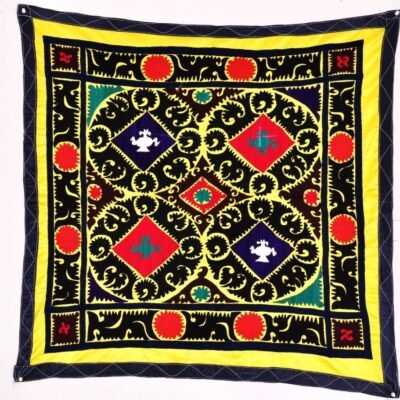
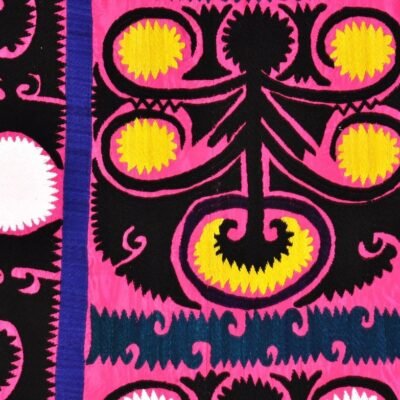
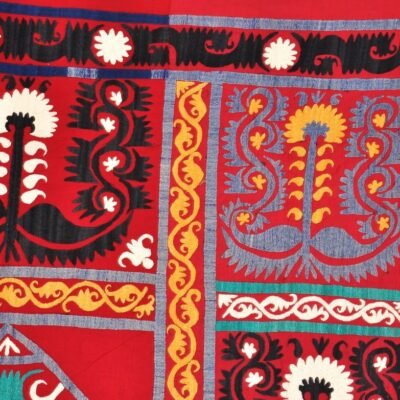
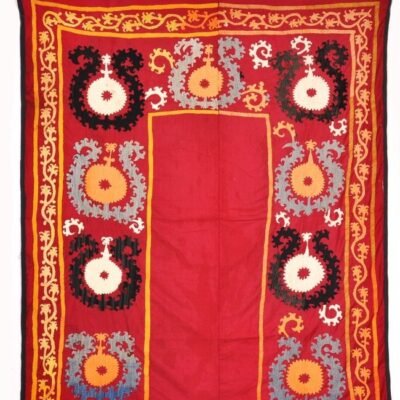
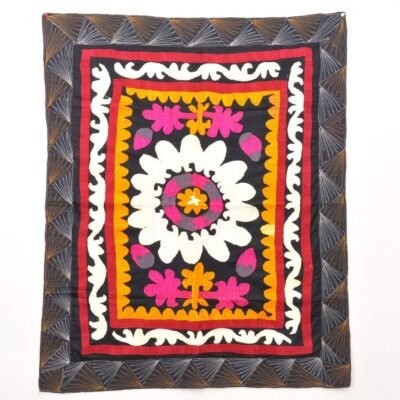
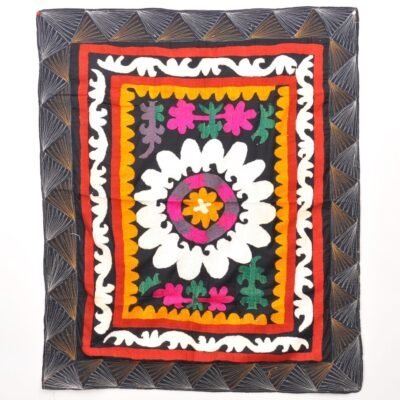
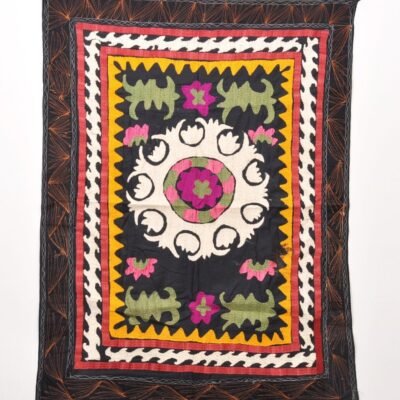
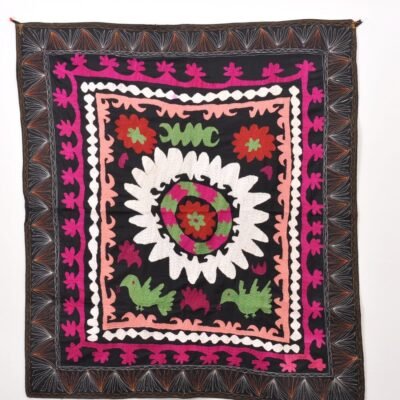
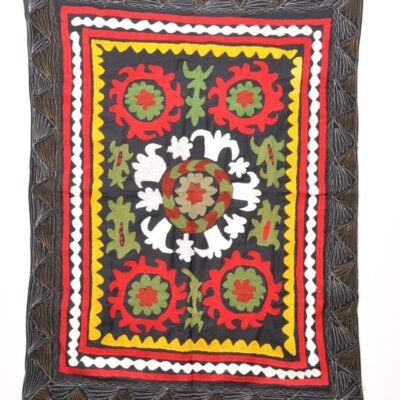
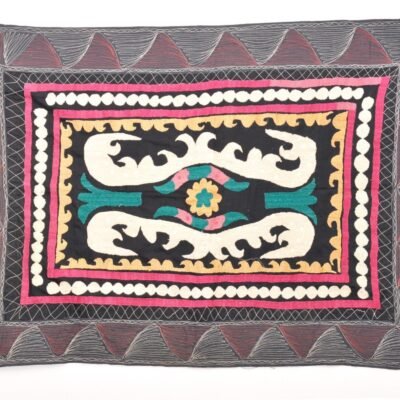
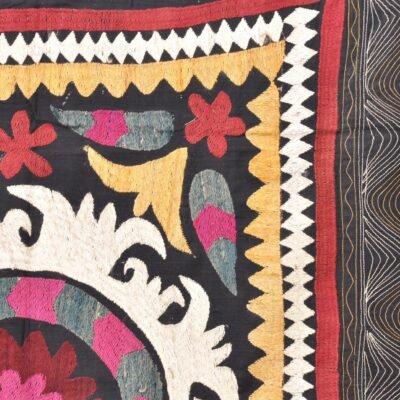
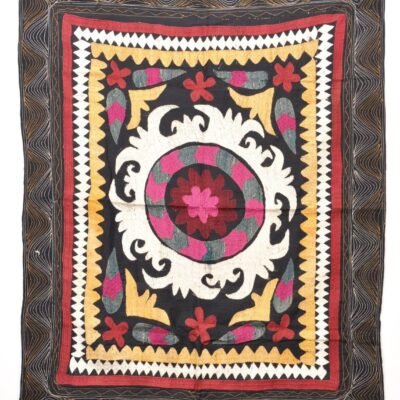
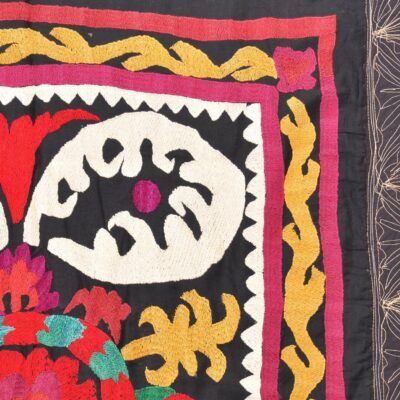
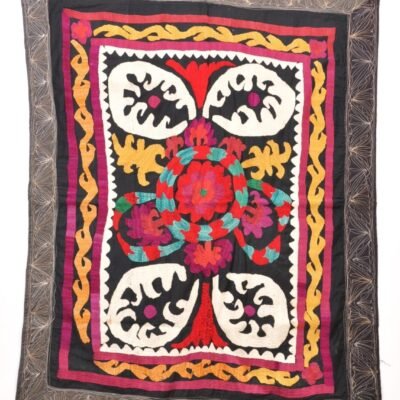
A suzani is a large embroidered cotton cloth — the word is Persian for “needle” — made in the towns of Uzbekistan for a bride’s dowry and hung, spread or draped in the house for the rest of her life. The pieces on this page are of two kinds, and each listing says which. About half are vintage: Soviet-era work of the 1960s to 1990s, silk on hand-woven cotton, bought from families in Bukhara, Samarkand and Tashkent. The rest are new, embroidered for us by Mukharram in Nurata and by Lutfiya in Bukhara and Shafirkan, in the styles their towns have used for two centuries.
Sizes run from 60 × 60 cm to 294 × 216 cm and are on every listing; prices from $24 for a small panel to $550 for a large hand-stitched piece. All are silk thread on cotton. For cushions cut from suzani, see suzani cushions.
Orders leave Bukhara within 24 hours by tracked airmail: USA 9–18 working days, Europe 8–16, elsewhere 10–20.




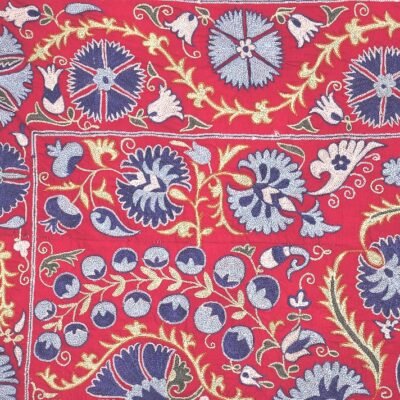
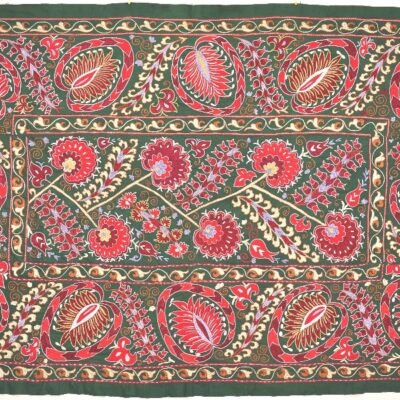
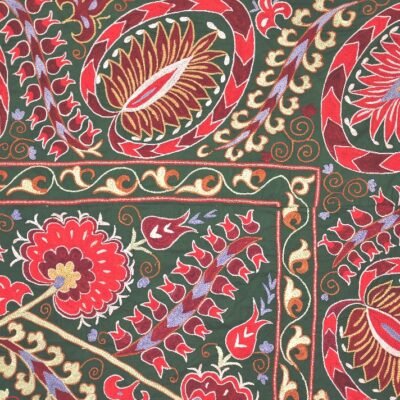
What a suzani is
The name is from Persian suzan, needle, and suzandozi is simply needlework. A suzani proper is a large decorative panel, not just any embroidery: the Soviet ethnographer Olga Sukhareva, who wrote the standard study, kept the word for the big dowry cloths and used other names for the smaller pieces. Very few survive from before the late eighteenth century, but the tradition is older — the Spanish envoy Clavijo saw silk-embroidered tents at Timur's court in 1404 — and the museum record is firm: the Victoria and Albert Museum's Bukhara suzani (no. 1276-1874) was bought in Tehran in 1874, 170 × 250 cm, silk on cotton, the same materials as every piece on this page. There is a longer introduction on our What's a Suzani page, and the measurements that suit a wall, bed, sofa or table are in the suzani size guide.
How one is made
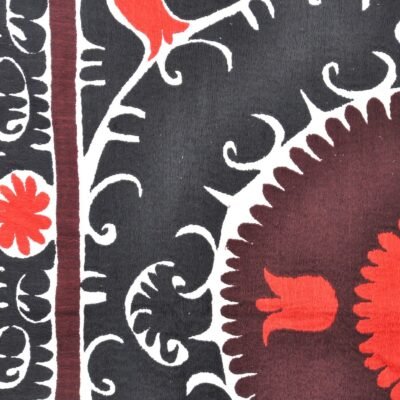
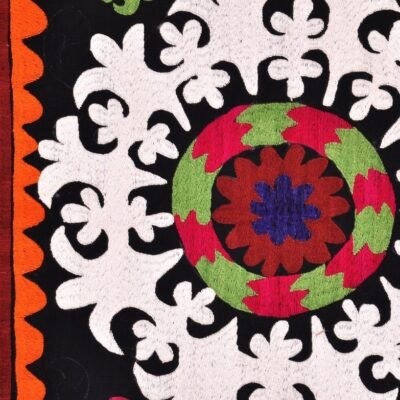
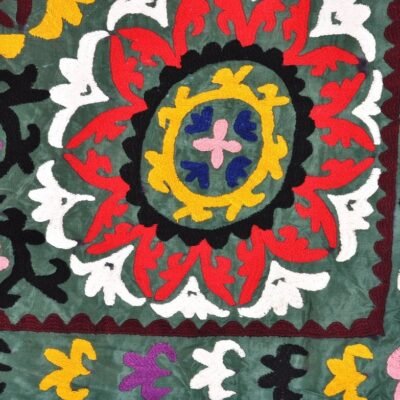
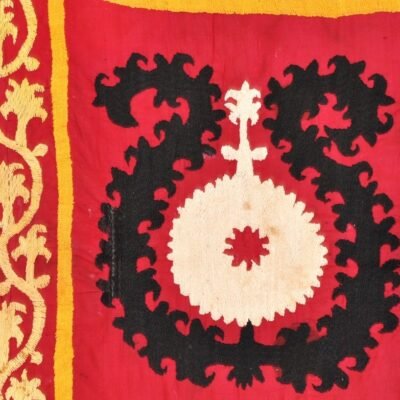
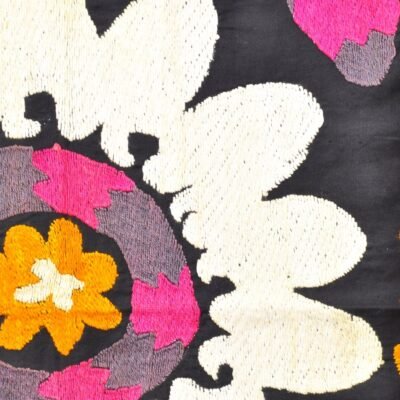
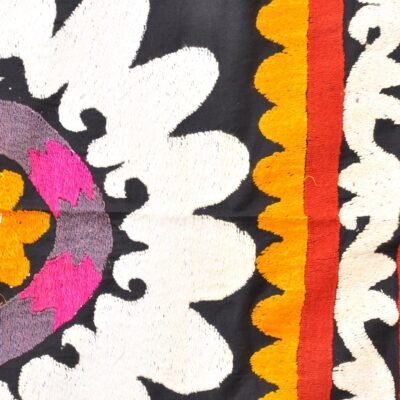
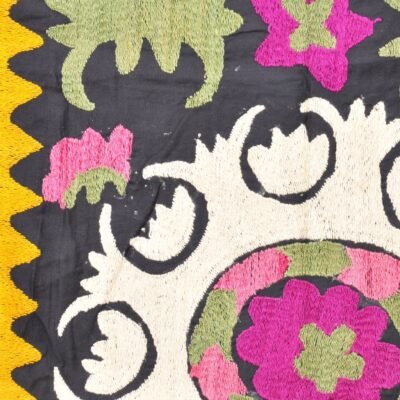
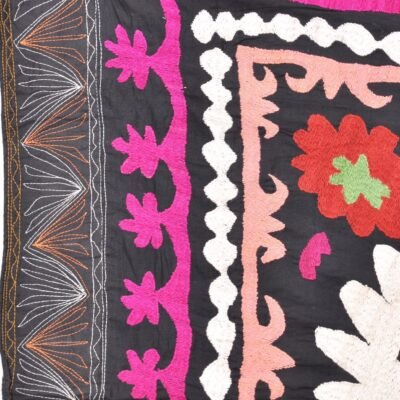
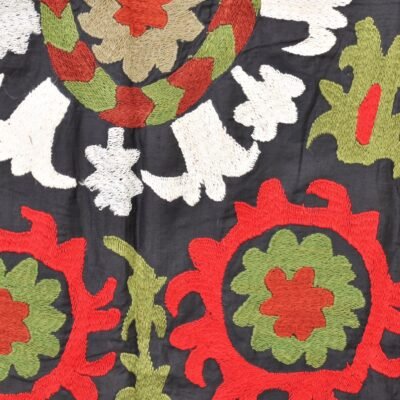
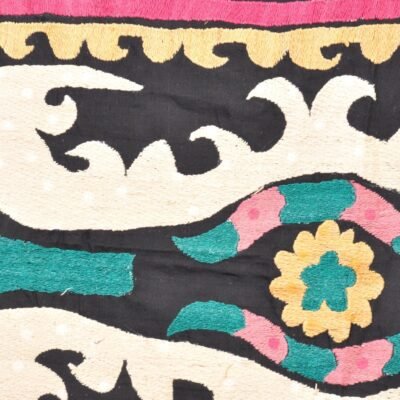
On four to six narrow strips of hand-woven cotton, a senior woman — the kalamkash — draws the design freehand with a reed pen. The strips go to several embroiderers, often the bride's mother, sisters and neighbours, who fill the drawing in silk; before a wedding the women of the street would finish a set together. The strips are then sewn back together, which is why on a real suzani the pattern jumps a little at the seams and the colour of a flower changes from one strip to the next. Those are not defects. Nor is the motif left deliberately unfinished in a corner — Uzbek women left it so that the evil eye would find no perfect thing to envy. The main stitches are basma, a couching stitch that lays a thick silk thread and tacks it down to fill large shapes, and yurma, a chain stitch worked with a fine hook; there is more in how a suzani is made.
The regional schools
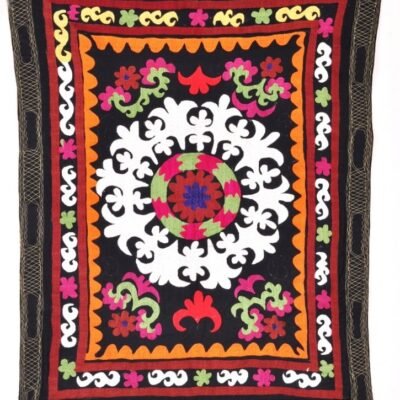
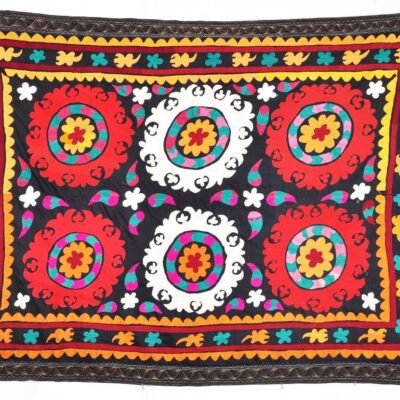
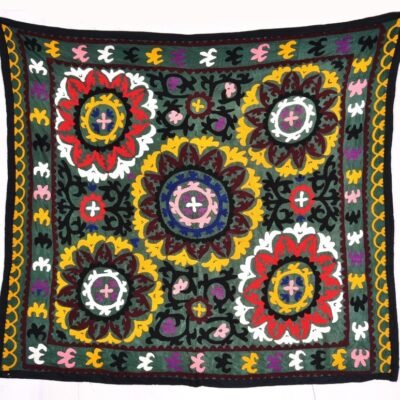
Uzbek embroidery is read by town. Bukhara: dense terracotta and crimson rosettes with fine vegetal scrolls, often in concentric circles, showing the influence of the Kashmir shawls that came through the bazaar. Nurata, the small town north of Bukhara where Mukharram works: airy, finely drawn flower sprays, and a signature layout of a central star with a bouquet in each corner — chor shokh u yak moh, "four branches and one moon". Samarkand: bold and sparse, big pomegranate-red rosettes ringed in green. Shakhrisabz: lush florals on a white ground. Tashkent and the Fergana towns: the palak, from the Arabic for "sky", a field filled edge to edge with huge dark-red circles that stand for the moon. Where we know the school, it is in the listing; where a vintage piece cannot be placed, we say so rather than guess.
Vintage and new, and how to tell
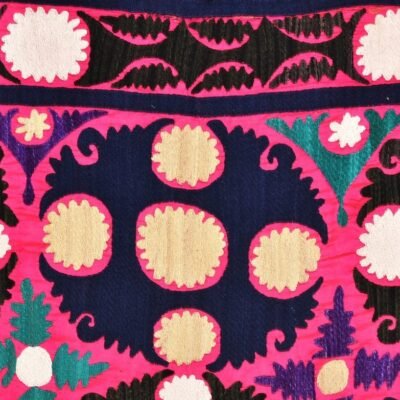
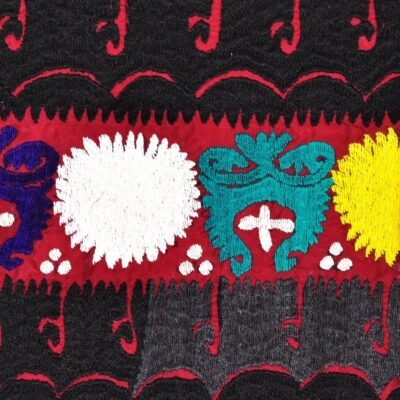
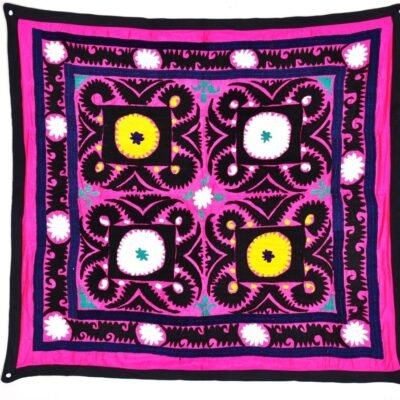
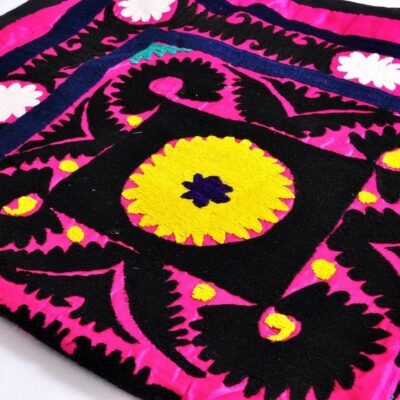
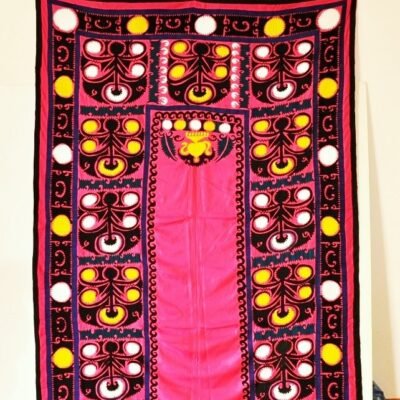
Uzbekistan's 1998 law forbids the export of cultural objects more than fifty years old, so nothing sold from Uzbekistan today is legally an antique, and we do not use the word. Our vintage suzanis are Soviet-era, roughly 1960s to 1990s: silk on cotton — hand-woven karbos or, later, mill cotton — often with the strong aniline reds and pinks of the period, and with the wear of a lived-in house — a faded edge, a mended corner, which the listing photographs show. Our new suzanis are embroidered in the same stitches by Mukharram and Lutfiya and their households, on hand-woven cotton, and they arrive clean, even and bright. Every piece in this section is hand-embroidered. To check any suzani, turn it over and look for the stitch travelling on the back, for uneven stitch density, and for the seams between strips.
Motifs, briefly
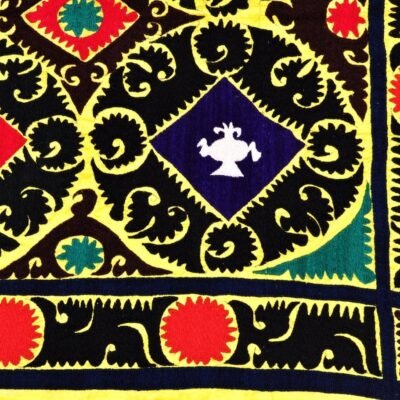
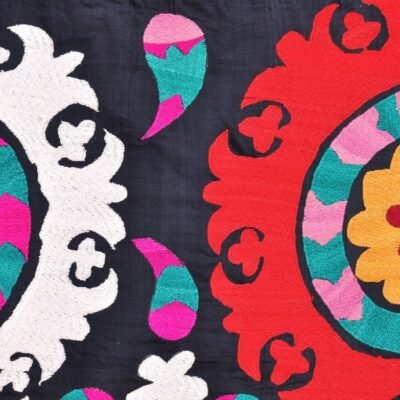
Rosettes and palmettes stand for fertility; the flower most often called a carnation in shop descriptions is usually a pomegranate blossom; tulips and hyacinths are Turkic, the boteh teardrop is Persian, and the lotus predates Islam in the region. The little water jug (aftoba) is purity, triangles are amulets, and a scorpion, when you find one, is there to protect, not to frighten. Our post on the symbols hidden in suzani goes through them one by one.
Dyes
Old suzanis were coloured with indigo, madder and cochineal, larkspur and pomegranate rind; synthetic dyes reached Central Asia in the late nineteenth century, and a Soviet-era piece will almost always carry them, which is why its reds are so saturated. If a new piece is worked in plant-dyed silk, its listing says so; where it does not, assume good modern dyes. More in natural dyes in suzani embroidery.
Sizes and how to use them
The dowry format is about 240 × 150 cm, made to cover a bridal bed, and our large suzanis (over 2 square metres — from about 140 × 150 cm up to 294 × 216 cm) hang above a sofa or a bed, or spread over one. Medium pieces (1–2 square metres) cover a table or a chest; small ones (under a square metre, from 60 × 60 cm) frame well, hang in a hallway, or become a cushion. To hang one, sew a sleeve of plain cotton along the top edge and pass a batten through it; never nail through the embroidery.
Care
Do not machine wash. A vintage suzani should be dry-cleaned by someone who has handled hand embroidery, or vacuumed gently through a fine net; a new one can be hand-washed in cold water with a mild detergent if the listing allows it, dried flat in the shade and pressed on the reverse over a towel. Keep all of them out of direct sun. Store rolled around a tube with acid-free tissue, not folded.
From the workshops
Our new Nurata suzanis are Mukharram's work — the sprays and the four-branches-and-a-moon layouts on this page are hers — and our new Bukhara and Shafirkan pieces are Lutfiya's, in the dense Bukhara manner. Both are named on their listings. Tell us if you need a particular size for a bed or a wall, and read why your purchase matters to the embroiderers.
Frequently asked questions
What is a suzani?
A suzani is a large hand-embroidered cotton cloth from Uzbekistan and its neighbours, silk thread on a cotton ground, traditionally made for a bride's dowry and used as a wall hanging, bedcover or table cover. The word is Persian for "needle". Alesouk sells vintage and newly embroidered suzanis from Bukhara, Nurata, Samarkand and the Fergana Valley.
Are Alesouk's suzanis vintage or new?
Both, and each listing says which. About half are Soviet-era pieces from the 1960s–90s; the rest are new, embroidered for Alesouk by Mukharram in Nurata and Lutfiya in Bukhara and Shafirkan. None are antiques: Uzbekistan bans the export of items over fifty years old.
Are suzanis hand-embroidered?
Yes. Every piece in this section is hand-embroidered in silk on cotton. On hand work the stitches travel across the back, the density varies, and the pattern shifts slightly at the seams between the cotton strips.
How big is a suzani?
Alesouk's suzanis run from 60 × 60 cm to 294 × 216 cm, and the size is on every listing. The traditional dowry format is about 240 × 150 cm. Alesouk files them by area: small under 1 m², medium 1–2 m², large over 2 m².
How much does a suzani cost?
At Alesouk, from $24 for a small vintage panel to $550 for a large hand-embroidered piece. Large suzanis (over 2 m²) are $124–550, medium (1–2 m²) $54–320, small (under 1 m²) $24–235.
What is the difference between Bukhara and Nurata suzani?
Bukhara suzanis are dense, with terracotta and crimson rosettes and fine scrolls, often in concentric circles; Nurata suzanis are airier, with finely drawn flower sprays and a central star with corner bouquets. Samarkand pieces are bold and sparse with large red rosettes; Tashkent palak pieces are filled with big dark-red circles.
How do I hang a suzani?
Sew a sleeve of plain cotton along the top edge on the back and pass a wooden batten through it, then hang the batten; never nail or staple through the embroidery. Keep it out of direct sunlight.
Can I wash a suzani?
Not in a machine. Dry-clean vintage pieces, or vacuum them gently through a net; hand-wash new pieces in cold water only if the listing allows it, dry flat in the shade and press on the reverse.
Does Alesouk ship suzanis to the USA and UK?
Yes, worldwide by tracked airmail from Bukhara, Uzbekistan, within 24 hours of the order: USA 9–18 working days, Europe and the UK 8–16, elsewhere 10–20. Duties, where charged, are the buyer's.