Join Our Newsletter
Subscribe to the Alesouk mailing list to receive updates on new arrivals, special offers and other discount information.
*By completing this form you're signing up to receive our emails and can unsubscribe at any time.


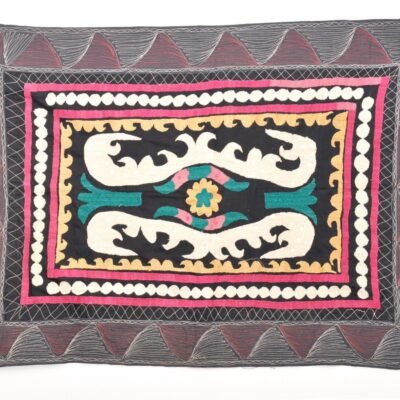
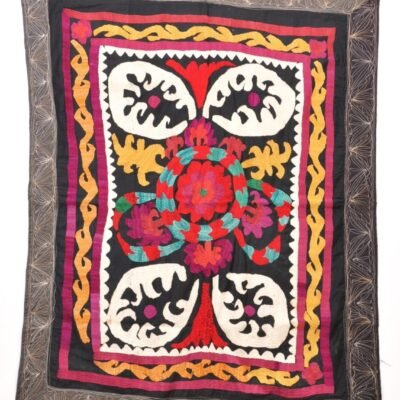
Suzani comes from the Persian suzan, needle; a suzani is literally “needlework”. The tradition belongs to the settled towns of what is now Uzbekistan and Tajikistan — Bukhara, Samarkand, Nurata, Shakhrisabz, Tashkent, Khujand and Ura-Tube (Istaravshan) — and the oldest surviving pieces date from the late eighteenth and early nineteenth centuries. The Castilian envoy Ruy González de Clavijo, who reached Timur’s court in 1404, described embroidered hangings that are usually read as the tradition’s ancestors, but no cloth from that date survives.
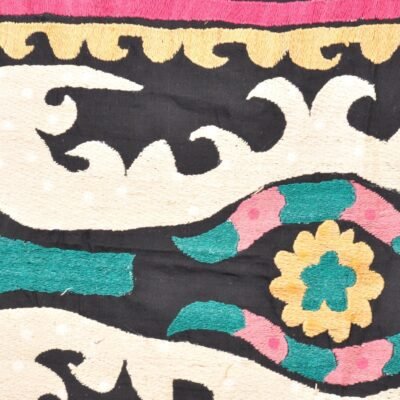
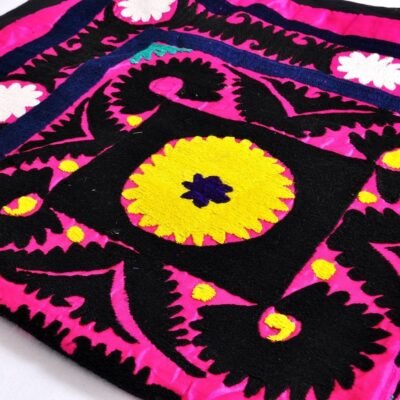
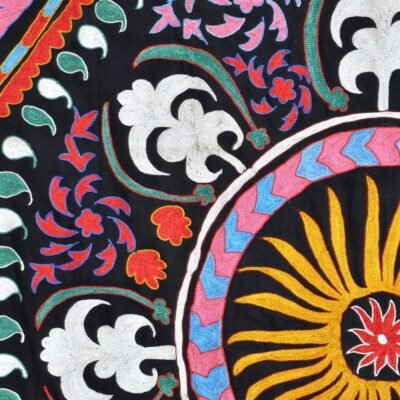
A suzani is cotton with silk on it. The ground is hand-woven cotton in narrow strips; the embroidery is silk thread in chain, satin and buttonhole stitch, with couching — a thick thread laid on the surface and sewn down with a finer one — for the raised outlines. Because the strips were worked by different hands and joined afterwards, the pattern shifts very slightly at every seam. That shift is the signature of hand work.

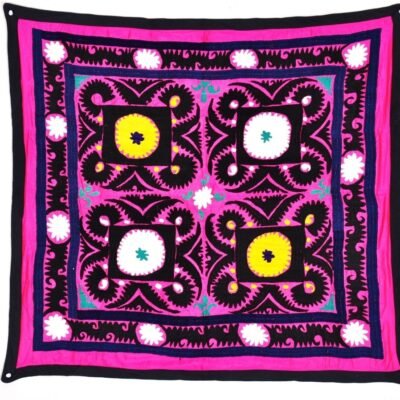
A finished piece. This is the most common confusion we see from shoppers who arrive from our ikat fabrics, which are sold by the metre and cut to order. A suzani is embroidered as one composition with a border, so it is sold whole, by its measurements: at Alesouk the pieces run from about 60 × 60 cm squares to dowry cloths of 294 × 216 cm, grouped as small, medium and large. You cannot order “two metres of suzani”; you choose a panel whose size fits the wall, bed or table, and the suzani size guide explains which size fits where.
The exception is cushions. Our suzani cushion covers are cut from embroidered panels and backed, mostly 50 × 50 cm. A panel cut into cushions is gone as a panel, which is why we cut only pieces that were embroidered for that purpose or are too damaged to hang.
The cotton is woven first, in strips about 30–40 cm wide. A senior woman, the kalamkash, draws the whole design freehand across the joined strips with a reed pen and ink. The strips are then unpicked and shared out — in the old dowry tradition among the bride’s mother, sisters and neighbours — and each woman fills her strip in silk. The strips come back, are sewn together again, and the border is finished last.
The stitches are few and the skill is in the density and the colour. Couching (basma) fills the fields; chain stitch (yurma, worked with a hook) draws the lines; buttonhole (ilmok) edges the motifs. A medium panel takes weeks of work; a large dowry cloth took a household the better part of a year. Our new pieces are embroidered for us by households in Nurata, Bukhara and Shafirkan, on hand-woven cotton, in the same stitches; the process is shown step by step in how suzani is made.
Each town had its own layout and palette, and the names are still used by dealers and museums:
A modern piece embroidered in Bukhara may follow a Nurata or Samarkand layout; the regional name describes the design, not always where today’s needle was.

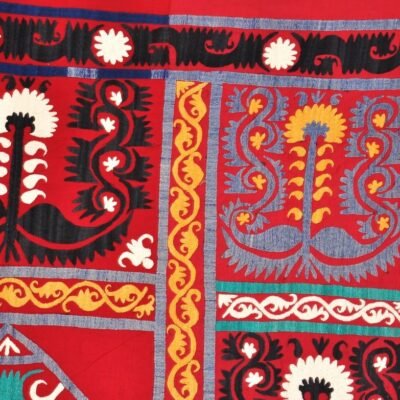
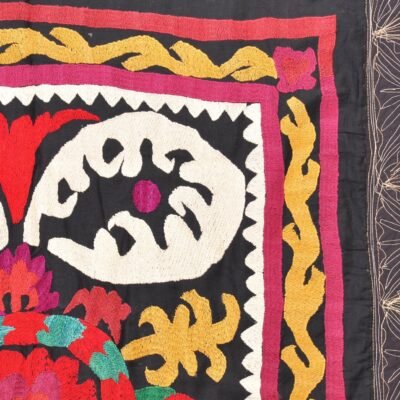
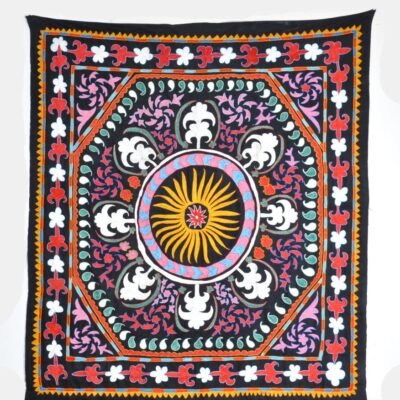
Pomegranates for fertility and plenty; tulips, carnations and irises; sun and moon disks; leaves and vines; the occasional bird or fish. Some old pieces have a motif left deliberately unfinished, which the makers said kept off the evil eye. The readings are traditional rather than fixed, and the women who stitched them were often more interested in a good arrangement of colour than in a symbol chart. What is constant is the structure: a field of repeated motifs inside a border, drawn to be seen from across a room.
Most “suzani” sold online at low prices are machine-embroidered on machine-woven cloth, and the listing rarely says so. Three checks tell them apart. Turn the piece over: on hand work the thread travels across the back in irregular lengths; machine embroidery shows an even, dense bobbin thread and often a stiff backing. Look at the stitch density: a hand-embroidered field varies from one strip to the next, because different hands worked it. Look at the seams: on a hand-made piece the pattern steps slightly where the strips join; a machine piece is continuous. Everything in our suzani embroidery section is hand-embroidered, and the photographs show the back where it matters.
“Silk suzani” means two different things. Almost all suzanis, old and new, are silk thread on a cotton ground: the cotton gives the weight and the silk gives the sheen. A silk ground — embroidery on silk or silk-cotton cloth — is rarer, lighter, more expensive and more fragile, and it was mostly used for smaller ceremonial pieces. When a listing says “silk suzani”, ask which it means. Ours are silk on cotton unless the product page says otherwise, and the cotton ground is what makes them robust enough to hang, lie on a bed or take a table.
A suzani was made for a wedding. Sets of them were begun years before a daughter’s wedding and finished for it: a large cover for the bridal bed, a hanging for the wall behind it, a prayer cloth with an arch (joynamoz), covers for the pillows and the bundle of bedding. They were displayed at the wedding and then used, which is why most old pieces show wear and the occasional mended corner. In the twentieth century they moved from the home to the market, and from the market to Western collections and interiors. Today they are used the way we sell them: on a wall, over a bed, across a sofa or down a table.
At Alesouk, “vintage” means a Soviet-era piece — decades old, not antique. Uzbekistan does not permit the export of objects more than fifty years old, so nothing we sell is older than that, and nothing on the site is called antique. Vintage pieces carry their history: faded aniline reds, a softened ground, a repair here and there, all shown in the photographs. New pieces are embroidered for us in the same stitches on new hand-woven cotton and arrive clean and even. The museum benchmark for the type is the Victoria and Albert Museum’s Bukhara suzani (no. 1276-1874), bought in Tehran in 1874, 170 × 250 cm, silk on cotton — the same materials as every piece on this site.

Measure the surface first. A wall above a sofa takes a medium panel about two-thirds of the sofa’s width; a double or queen bed takes a large piece; a dining table takes a medium panel as a centre cloth or a 50 × 145 cm runner. The size guide works through each case with the measurements of the pieces in stock. To hang one, sew a cotton sleeve along the back of the top edge and pass a batten through it; never nail through the embroidery. Keep it out of direct sun, do not machine wash, and have a vintage piece dry-cleaned by someone who has handled hand embroidery.
The towns of Uzbekistan and Tajikistan — Bukhara, Samarkand, Nurata, Shakhrisabz, Tashkent, Khujand — where it was made for weddings. Related embroidery exists across Central Asia, but “suzani” in the textile trade means these Uzbek and Tajik dowry cloths.
Embroidery. The cotton ground is woven plain and the whole design is stitched on afterwards. Our ikat, by contrast, is a woven cloth whose pattern is dyed into the threads before weaving.
Ours run from about $43 for a small square to around $495 for the largest dowry cloths, and the price is on every listing. Hand work, size and condition set it; a machine-made “suzani” at a fraction of that price is a different product.
Not as yardage. Upholsterers do use suzani panels for headboards and chair backs, cutting a single panel to the piece; for seats and for anything sold by the metre, see our ikat upholstery fabric.

Subscribe to the Alesouk mailing list to receive updates on new arrivals, special offers and other discount information.
*By completing this form you're signing up to receive our emails and can unsubscribe at any time.

Every piece is hand-embroidered in silk on a cotton ground and sold whole, by its measurements, in small, medium and large; cushion-sized pieces are in the suzani cushion covers. Not sure which size? Read the size guide or ask us with your measurements.
Shop Suzani Embroidery